The heyday of musicals has long since come and gone. In fact they peaked in the late 50s and early 60s (think 'Music Man', 'Oklahoma', or the real blockbuster that basically killed off the genre for a generation-- 'The Sound of Music'). Basically those sorts of musicals were exported from the Broadway stage in NY to the studios in L.A. and became major films. 'Hairspray' is in fact another good example of that sort of phenomenon. The difference of course is that in film, you can fake the singing, whereas on stage, either you got it or you don't when it comes to singing and dancing.
Of course there have been notable surprises in the past twenty years that showed that the musical on film could still be a hit-- 'Grease' of course was a good example (and the music in 'Hairspray' is mostly a recreation of that same do wop period), and more recently 'Chicago' was certainly first rate and won various awards. How then will 'Hairspray do?
First of all it seems clear that the producers realized that two things were required-- star power and great music and dancing. Fortunately for the producers the music was already widely acclaimed to be good from the reviews of the Broadway play, so it was more about the casting. So what did they do? Well they picked two people who had been absolute stars of the two biggest more recent examples of this genre--- John Travolta from 'Grease' fame, and Queen Latifah from 'Chicago' fame. But not satisfied with that, they went out and got Michelle Pfeiffer to play the mol who is the TV show producer, and Christopher Walken as Travolta's--- well husband (you see Travolta plays the stay at home big momma who takes in laundry in this movie). And as if that were not enough we have Allison Janey in a cameo role as a really up tight Catholic mom. At center stage however is first timer Nikki Blonsky from N.Y. who is only three years away from watching 'Hairspray' as a mere spectator. She is terrific, as is the cast in general. Interestingly the setting for the show is not NY or NJ, but rather Baltimore. Who knew Baltimore was the center of the do wop universe?
Movie musicals are usually about as mainstream and apple pie as one could possibly imagine, shying away from anything that looks like controversy, but not 'Hairspray'. No indeed. Not only does it plug the message 'it's o.k. to be big and beautiful' (with Travolta, Queen Latifah, and Blonsky all doing their part to show its o.k. for the large to be in charge and 'get down'), but in fact this show turns into an integration and inter-racial dating promo as well-- all set in 1962 Baltimore. Which part of trying to do too many things in one play/ film don't they get? Yet somehow it all comes together and works.
Now about the music, because without the music, well, let's just say the plot will not be winning any awards for creativity or best script. The music, with hommages to big band music, show tunes, do wop, and even some soul and gospel, is first rate, and original. Because it is a musical we expect a lot of music, but in 'Hairspray' as in 'Chicago' it is almost non stop upbeat music, some of which goes for the jugular as pull out all the stops huge dance numbers with big finishes. Undoubtedly the producer and director wanted this film to have the same energy and drive as the play, and they succeeded quite well. There is very little dialogue or plain talking in this movie. And this brings us to an important point.
Musicals like opera, requires a significant suspension of disbelief. As the old saying goes in opera when someone is stabbed instead of dying right away, they sing for a while. In musicals, almost anything serves as an excuse for singing and dancing-- even detention at high school is turned into a song and dance routine. If detention had been like that, I would have tried to sit in on that class. You have to love music and dancing, to suspend your disbelief as much as is required for a movie like 'Hairspray' to work. And yet it does work.
The movie clocks in at a breathless one hour and 47 minutes (you have to be in shape to sing and dance that long almost non-stop), and it ably re-creates the feel of 1962 when the Platters and the Drifters and the Coasters were kings. And this brings up another point. The Beatles had not yet hit America, changing it forever musically, nor frankly had major integration marches hit the streets before a little later in the 60s. This show then is stealing a message from later in the 60s while wanting to live musically earlier in the 60s. No matter-- this show is not trying to be a history lesson, just some fun with a little social conscience.
Inquiring minds may want to know-- does Travolta work as a large woman? Well, yes, and no. His voice is frankly too phony southern to suit a real southerner like myself. On the other hand Michelle Pfeiffer does a racist Cat woman impression pretty good, and Christopher Walken is just plain funny as the father/ husband and owner of the novelty shop The Hardy Har Hut. I could have done without the slam on over-protective Catholic mothers, as played out quite brilliantly by Allison Janey, but then there were folks like that, in that era. Unfortunately Christianity doesn't come off to well in this film.
Is this a film for families to see? Well, I guess it depends on the family. If they are teens and adults, I suppose it will be fine, but some of the racier dancing and innuendo in this film will be too much for some Christian families. The joy and fun of the music doesn't overcome all the drawbacks of the film. Is 'Hairspray' another hare-brained musical? Well no, it's not. Nor is it mere fluff either. But whether it will win the awards 'Chicago' won is doubtful. As summer fun however, many are already enjoying it.
Friday, July 20, 2007

The Seer's Tower
From here I can see tomorrow,
From here I can see the shore,
From here I can see the future,
But I ask myself, what for?
Somewhere between curse and blessing
Between help and hindrance
Is knowing what’s coming
Preparing for the dance.
Would you want to know the outcome,
If it turned out you would lose?
Would you want to know the verdict,
If it’s not what you would choose?
Would you want to know the future,
If it ends badly for those you love?
Would you want to know the future
If it’s a vulture, not a dove?
But what if the future’s not totally fixed
And there’s still time for a change?
What if it’s not all written in stone,
And hope’s not out of range?
What if God only gives us glimpses
Of what will someday be,
But he let’s us fill in the blanks
Between here and eternity?
What if we have a role to play
In the grander scheme of things,
What if we have at least some say,
In who will wear the rings?
What if God only reveals
Enough of the future today
To give us hope and encouragement
But not remove the need to pray?
What if we see through a glass darkly,
And most of the objects aren’t clear,
Things look closer in the mirror,
Than they actually are from here?
Pundits and prognosticators
The weather men of time,
Are often over-confident
Ridiculous, not sublime.
Take predicting the return of Jesus,
Many have boldly bet,
They all have one thing in common,
They’ve never been right—yet.
When you have that sort of failure rate
Reticence is required
Lest you be dubbed false prophet,
Your predictor’s license expired.
The prophecies raises expectations
That God will see things through
They don’t encourage calculations,
Which tell God when he’s due.
Prophecy is not about calculation
Nor prognostication at all
Those are human preoccupations
Not part of the Almighty’s call
Prophecy is about God’s promise
That all will be well one day,
It does not tell us when or where
It’s not for us to say.
Prophecy paints the big picture,
Of justice and mercy at last,
It does not give us the co-ordinates
It does not say how fast.
There’s a reason for this reticence
God’s in control of time
He has not handed us the helm,
Only He knows the reason and rhyme.
Only he knows what is best for all of us,
Only he knows when to bring it to pass
Only he knows where it’s all going,
And how long it ought to last.
God will never make our lives
So we don’t need to trust
He will never make his creatures
So that prayer is not a must.
We will always be his creatures
Who must rely on his loving care
I am sure he is tired of our asking
“Aren’t we already almost there?”
When faith finally becomes sight,
And hopes are realized,
When the eschatological dust clears
And we see with new creation eyes
There will be one thing left standing
That we’ve been trusting all along,
A loving God’s desire and ability
To finish his own love song.
The reason love is yet greater
Than faith or even hope,
Is because it endures forever
And enables us to cope.
Climb down from your own seer’s tower
Place your life in the Father’s hands,
For he always knows what’s best for us,
And he gives what he commands.
Stop writing fear-based fiction
It needs to be left behind
It dishonors our loving Maker
Abandons the faith-based design.
Someday we will see our Savior
Someday we will know, as we're known,
In the meantime stop playing God,
And leave the future alone.
When Christ returns let him find you,
Doing what he made us for,
Loving people into the kingdom,
Feeding and clothing the poor.
Inasmuch as you've done it unto the least of these,
You've done it unto the Lord,
Let him find you imitating his actions,
Not frightening the faithful but bored.
Let him who runs read the writing
That's written on the wall,
'Take up your cross and follow me,
Sacrifice and serve them all'.
'Parting is all we know of heaven,
And all we need of hell'*,
Those who simply trust the Lord,
Will find that they've done well.
July 20 2007
BW3
* E. Dickinson-- Poem 96, "My Life Closed Twice..."
Thursday, July 19, 2007
Gender Battles that Compute


A Spanish teacher was explaining to her class that in Spanish, unlike English, nouns are designated as either masculine or feminine.
"House" for instance, is feminine: "la casa."
"Pencil," however, is masculine: "el lapiz."
A student asked, "What gender is 'computer'?"
Instead of giving the answer, the teacher split the class into two groups, male and female, and asked them to decide for themselves whether "computer" should be a masculine or a feminine noun.
Each group was asked to give four reasons for its recommendation.
The men's group decided that "computer" should definitely be of the feminine gender ("la computadora") because:
1. No one but their creator understands their internal logic;
2. The native language they use to communicate with other computers is incomprehensible to everyone else;
3. Even the smallest mistakes are stored in long term memory
for possible later retrieval; and 2. The native language they use to communicate with other computers is incomprehensible to everyone else;
3. Even the smallest mistakes are stored in long term memory
4. As soon as you make a commitment to one, you find yourself spending half your paycheck on accessories for it.
The women's group, however, concluded that computers should be Masculine ("el computador") because:
1. In order to do
anything with them, you have to turn them on;
2. They have a lot of data but still can't think for themselves;
3. They are supposed to help you solve problems, but half the time they ARE the problem; and,
4. As soon as you commit to one, you realize that if you had waited a little longer, you could have gotten a better model.
I'm sure you know who won!
2. They have a lot of data but still can't think for themselves;
3. They are supposed to help you solve problems, but half the time they ARE the problem; and,
4. As soon as you commit to one, you realize that if you had waited a little longer, you could have gotten a better model.
I'm sure you know who won!
----------
WIFE vs. HUSBAND
A couple drove down a country road for several miles not saying a word. An earlier discussion had led to an argument and neither of them wanted to concede their position.
As they passed a barnyard of mules, goats, and pigs, the husband asked sarcastically, "Relatives of yours?"
"Yep," the wife replied, "in-laws."
W O R D S
A husband read an article to his wife about how many words women use a day...30,000 to a man's 15,000.
The wife replied, "The reason has to be because we have to repeat everything to men...
The husband then turned to his wife and asked, "what ?"
CREATION
A man said to his wife one day, "I don't know how you can be so stupid and so beautiful all at the same time.., "The wife responded, "Allow me to explain, God made me beautiful so you would be attracted to me; God made me stupid so I would be attracted to you!"
THE SILENT TREATMENT
WIFE vs. HUSBAND
A couple drove down a country road for several miles not saying a word. An earlier discussion had led to an argument and neither of them wanted to concede their position.
As they passed a barnyard of mules, goats, and pigs, the husband asked sarcastically, "Relatives of yours?"
"Yep," the wife replied, "in-laws."
W O R D S
A husband read an article to his wife about how many words women use a day...30,000 to a man's 15,000.
The wife replied, "The reason has to be because we have to repeat everything to men...
The husband then turned to his wife and asked, "what ?"
CREATION
A man said to his wife one day, "I don't know how you can be so stupid and so beautiful all at the same time.., "The wife responded, "Allow me to explain, God made me beautiful so you would be attracted to me; God made me stupid so I would be attracted to you!"
THE SILENT TREATMENT
A man and his wife were having some problems at home and were giving each other the silent treatment. Suddenly, the man realized that the next day, he would need his wife to wake him at 5:00 AM for an early morning business flight.
Not wanting to be the first to break the silence (and LOSE), he wrote on a piece of paper, "Please wake me at 5:00am." He left it where he knew she would find it.
The next morning, the man woke up, only to discover it was 9:00 AM and he had missed his flight....
Furious, he was about to go and see why his wife hadn't wakened him, when he noticed a piece of paperby the bed. The paper said, "It is 5:00 AM, Wake up." Men are not equipped for these kinds of contests....
Remember:
God may have created man before woman, but there is always a 'rough draft 'before the masterpiece.
Wednesday, July 18, 2007
The Long Day's Journey-- My Boston Marathon Experience
 O.k., so the picture is sideways. That's about how I got across the finish line in the Boston Marathon-- crawling sideways. Turn your computer sideways and look. Actually if you right click on the picture, I gather you can make it much bigger and right side up in Adobe Photoshop.
And yes that's really me crossing the finish line at the Prudential tower, completely out of gas. I finished behind most of the elite runners, and ahead of Mayor Flynn. It was a very hot day for Patriot's day in April 1993, and many of the elite runners dropped out of the race by Heartbreak hill.
But what I want to talk about in this post is how physical experiences can prompt, or actually be amazing spiritual experiences. There is something about reaching the end of yourself physically that seems to open yourself up to God in whole new ways. You reach what is often called a limnal state.
The race began with me walking to the front of the pack to get one fleeting glimpse of the elite runners-- the Kenyans and Nigerians. Enormous legs, otherwise they looked like they hadn't eaten in weeks. Very thin and wiry. I knew I would never see them again, so I figured I needed to see them at the start. You see there were over 5,000 runners on that day-- and as I said it was very hot for an April day. Lots of folks went out hard without drinking enough H20. I saw them later on stretchers on the side of the road at Wellsley-- it looked like a mash unit had come to town.
I saw some amazing sites along the way from Hopkinton to downtown Boston. For one thing I saw a man pushing his quadrapeligic son the whole 26 miles. He was running at a good clip too. I also saw a crazy person with a rainbow afro running back and forth across the course with a T shirt on that said 'Kiss me, I'm Jesus'. Somehow, I begged to differ. If that was Jesus incognito then for sure I had been practicing the wrong religion for many years.
And of course there were the temptations along the way--- one bar right along the road in Ashland Mass. had a big sign up-- 'stop in here-- free beer for the runners'. I wondered if they provided free Porto-johns down the road a few miles as well.
When I got to Chestnut Hill and passed BC there were a lot of Catholics out cheering us on-- some of those nuns had bad habits, but they were enthusiastic and I needed the help. I am not fast, but my stamina was pretty good back then. When I arrived at Newton the fire department was spraying everyone, including me, and when they saw I had the number 1993 (which was also the year) they wanted a group photo with me-- I said sure. I wish I had that photo now.
Heartbreak Hill, which is really several hills going for several miles through largely Jewish neighborhoods was tough for three reasons: 1) Alberto Salazar quit there he was so dehydrated. He had just won the NY marathon the previous year-- if he couldn't make it through the heat, why should I assume I could; 2) I ran into a young man half my age who was badly cramping up-- he was in tears. He had trained for a long time for this, and it was his dream to finish the Boston Marathon. It didn't look like it could happen on that day; 3) then there was the 75 year old granny shaming me up the hill. She was still running beside me and she said "Come on sonny, let's go up this hill". I was tempted to say "you go right ahead mam, I am basically dead." But somehow I got over that hill. Even Johnny Daily who had run the marathon since the 30s, and won it in the 30s had only run part of the race. Who was I to think I could finish?
When I got past Newton, the cable cars above ground were filled with portable cheering sections, otherwise known as students. They were moving minimally faster than me, but they were cheering me on. It was amazing. And then I turned the corner onto Commonwealth, and then I saw the Prudential tower and my legs buckled. I was overcome with emotion. I had been running on empty for a while and praying-- 'are you running with me Jesus'? Somehow he was there too.
And then there was my best friend standing at the finish line, Rick Sanders, taking my picture-- yes that picture above. Yes, it took me 5 hours to finish. I knew if I went too fast in the heat, I would never finish at all. But I did. When I crossed the finish line it was like I had entered the Kingdom. I collapsed in the arms of a lady who was a nurse, busy wrapping me in NASA foil. I was tempted to say-- 'great, that's just what I need, to conduct more heat to my body just now' but I was too exhausted to protest. With a lot of help from above, I had finished. I sat down and just wept-- tears of joy. Thanking the Lord. I had run a marathon once before in Cleveland in 1990 in the May heat, but it was nothing like this.
Which brings me to my subject for today. The interface between the physical and the spiritual. I have a theory. It is that we use an awful lot of things to hold God at bay in our lives. One of them is our physical resources. When we are feeling fine, we motor right along, but when we are sick, tired, and sick and tired, then we are all about calling on the One for extra help and strength. Sometimes we really do have to come to the end of ourselves to come to the beginning of God. What is remarkable is how patient God is with our arrogance and silliness as we hold Him at bay, and think we can take care of ourselves and are just fine.
Many years later I was studying Hebrews 11-12, and discovered that it talks about Jesus himself as the trailblazer and finisher of the race of faith and faithfulness. The text says we must keep our eyes on the lead runner, Jesus. It says we must leave behind the things that encumber us, particularly the sins that have been dragging us down like a runner's leg weights. Then it talks about being surrounded by so great a cloud of witnesses, who are cheering us on to the heavenly or eschatological finish line. I felt that, that day.
You see marathoning is perhaps the loneliest of all competitions. You can't lean on anyone else, you can't coast on your bicycle for a while, it's not at all a team sport. Either you do it, or it doesn't get done, or so many would tell you. They see it as the ultimate expression of radical and rampant individualism, and individualistic accomplishment. But actually they are wrong. No one could run a 26 marathon if the course was not properly marked out. They would get lost. And in fact apart from the very lead runners, most would get lost anyway if there were not others running beside them and observers cheering them on, handing them water, spraying them down, etc. Most runners get tunnel vision in a long race and rely on sensing other runners around them to give them a sense they are on the right track. And then there are the shoes-- its all about the running shoes. Without them, maybe only a Kenyan or two could go the distance. Somebody else made the equipment that made it possible. Come to think of it, no one does it without a lot of help. You could never carry enough water on a day like that and run the whole course. Somebodies had to be spaced along the way with water to hand you.
But none of this is as important as the psychological strength, the inner strength to get there, and that needs bolstering at numerous times along the way, even if one is in good shape. There is still that seed of doubt, especially on a hot day, about whether it might be possible to go the distance. Which brings me back to my prayer-- Jesus WAS running with me. I sensed it strongly near the end when every sinew cried out--- 'stop the madness now'. I sensed it when I was overcome emotionally in seeing the Prudential tower.
Rarely, but occasionally in this life we get a glimpse of the veil being lifted and we see the interface between time and eternity, this world and the next. I saw it that day. I remembered the words of my favorite John Muir saying-- "Most days, we look at life from the back side of the tapestry, and all we see is loose ends, knots, dangling individual threads. But occasionally light shines through the tapestry, and we get a glimpse of the larger divine design, weaving together the darks and the lights into a beautiful pattern (see Rom. 8.28). All things did work together for good on that day, although afterwards I felt like a Norse God-- Thor, very Thor. I went home to Rick's and soaked in the tub for who knows how long-- with a Cheshire cat grin on my face. I had fought the good fight, run the race, and finished the course. It was a day I will never ever forget. But compared to the race to the Kingdom, and the endurance that takes, the Boston Marathon is but a small preview of such coming attractions.
Tuesday, July 17, 2007
THE MAZE
VOICE ONE—THE CONSCIENCE
You don’t get there sooner
Running faster in that direction,
It only ruins your temper
Your color and complexion.
VOICE TWO—THE EMOTIONS
If you can’t remember
Whether you’ve been here before
I fear you’ll never find
The exit or the door.
VOICE THREE—THE WILL
You grow weary of the game
You grow wary of the claim
Cause all paths look the same,
And no one is to blame.
VOICE FOUR—THE MIND
Did you take the trouble
To think the path through,
Before you even started,
Before you turned blue?
VOICE ONE
Are you going round in circles,
Retracing your selections,
Has it occurred to you,
To ask for directions?
VOICE TWO
Every turn you take,
Every move you make,
Every path you forsake,
Could be a mistake.
VOICE THREE
Some are not phased
By a complex maze,
It doesn’t take days,
Or leave you amazed.
Seeing the end from the beginning,
Shows you which way to go,
If only you’d had the foresight,
To start off quite slow.
VOICE TWO
And now it’s getting dark,
And all the noises gone,
Should I just stop and rest,
Should I be moving on?
VOICE FIVE
‘My Word is a lamp unto your feet,
And a light unto your path’
BW3 July 17 2007
Monday, July 16, 2007
'Potter V'-- The Trouble with Harry
Oh for the good old days of riding one's broom and playing quidditch. Harry has moved on from those mostly care-free days and now is presented to us as a troubled youth. The trouble with Harry is that he is not only haunted by his past, his loss of his parents and various other troubling events, he's being hunted, mentally at least by Lord Voldemort (a newer version of Dr. Death or Darth Vader). There is some connection between Harry and the dark lord, and its driving him bonkers as evil creeps into his mind. Add to this the conflicting feelings of puberty and you have one nicely mucked up Harry who has become short-tempered, and even stand offish with his dearest friends. His saving grace is his relationship with Sirius Black, some sort of relative, but even that goes for naught before this movie is done.
Like the last movie, J.K. Rowling in 'The Order of the Phoenix' is once more diving into the deep end of the pool of evil, though for some reason this movie seemed less heavy and foreboding than the last one-- perhaps because no children are destroyed in this one. The movie is a well paced one, clocking in at 2 hours and 14 or so minutes, and their really is no filler. It is full of CG magic (I especially like the animated tea plates on the wall with kitties mewing and moving around), and pleasant set pieces (including flying over London on brooms), but the story line percolates along rather well without interruption.
Unfortunately Hogwart's has been taken over by the Ministry of Magic (headed by Fudge-- ably played by Edward Hardy of 'All Creatures Great and Small Fame') and a headmistress in pink one Ms. Umbridge (as in 'I take umbridge at that'), who clearly was trained in the No Fun League begins to squeeze all the possible joy she can out of school and put all the deadly rules in she can. One begins to wonder if she is actually in league with the dark lord herself. Headmaster Dumbledore continues to be his affable and pleasant self, and Severus Snape is his usual melancholy self, but most of the other instructors we are by now used to at Hogwarts make no more than cameo appearances. The story focuses on the psychological struggles and drama going on in the life and mind of young master Potter. Left behind is the rivalry with other students (e.g. the aptly named Malfoi-- which means 'bad faith' hardly appears) in order for the larger struggle with evil to take center stage. Not left behind, but not as central as before, is Harry's relationship with Ron and Hermione, his two best chums. In fact, at one juncture Harry has his first kiss, and its with a girl we have not previously met before this movie.
One of the things about Rowling's novels as they have developed over time is that they have certainly become longer and more complex, and the story telling has become more adult. One wonders what small and mid-sized children are doing at movies like this, and what they make of it. Clearly much of what is going on and the nuances of the psychological drama will be well over their heads, and the dark images frankly too dark for most children.
The phoenix of course was the bird which rose from the ashes, apparently from the dead, and it not surprisingly became one symbol in early Christianity for the resurrection. It is no accident that this episode is named 'the Order of the Phoenix'. This refers to a group of good magicians who have banded together to rise up and fight the evil, and Harry, in his own fashion starts a student chapter of the order at Horgwarts, complete with training sessions in spell casting or zapping of bad things with a wand.
There is a juncture in the movie where there is a very crucial and serious discussion between Sirius Black and Harry. Sirius reminds Harry that the world is not composed of those who are all good, on the one hand, and those who are nothing but evil on the other. "Most people are a mixture of good and bad" Harry is reminded. This presumably is meant to help Harry not be so hard on himself when he has dark thoughts, but Sirius also stresses that Harry is a good person with some flaws, and he should not doubt his goodness, nor blame himself for all that has gone wrong. The message, if there is one, is that ordinary persons with some goodness in them, can strive to be their best selves, and overcome their temptations to give way to darkness.
Various of the reviewers of this movie have commented on the fact that it seems like an interim report, before we get to the real epic struggle between good and evil. This is a helpful observation, and it is in this movie that we hear the prophecy that either Voldemort or Harry must be done away with before the resolution of the drama. That is barely on the horizon here. The good news for now is that Harry is able to fight off the mental invasion of darkness into his fertile and sensitive mind.
So we must bide our time until the penultimate installment of these films comes out-- 'the Half-Blood Prince' in a year or so. In the meantime, start working on your wand waggling-- evil is coming to town and will not be messing around.
Like the last movie, J.K. Rowling in 'The Order of the Phoenix' is once more diving into the deep end of the pool of evil, though for some reason this movie seemed less heavy and foreboding than the last one-- perhaps because no children are destroyed in this one. The movie is a well paced one, clocking in at 2 hours and 14 or so minutes, and their really is no filler. It is full of CG magic (I especially like the animated tea plates on the wall with kitties mewing and moving around), and pleasant set pieces (including flying over London on brooms), but the story line percolates along rather well without interruption.
Unfortunately Hogwart's has been taken over by the Ministry of Magic (headed by Fudge-- ably played by Edward Hardy of 'All Creatures Great and Small Fame') and a headmistress in pink one Ms. Umbridge (as in 'I take umbridge at that'), who clearly was trained in the No Fun League begins to squeeze all the possible joy she can out of school and put all the deadly rules in she can. One begins to wonder if she is actually in league with the dark lord herself. Headmaster Dumbledore continues to be his affable and pleasant self, and Severus Snape is his usual melancholy self, but most of the other instructors we are by now used to at Hogwarts make no more than cameo appearances. The story focuses on the psychological struggles and drama going on in the life and mind of young master Potter. Left behind is the rivalry with other students (e.g. the aptly named Malfoi-- which means 'bad faith' hardly appears) in order for the larger struggle with evil to take center stage. Not left behind, but not as central as before, is Harry's relationship with Ron and Hermione, his two best chums. In fact, at one juncture Harry has his first kiss, and its with a girl we have not previously met before this movie.
One of the things about Rowling's novels as they have developed over time is that they have certainly become longer and more complex, and the story telling has become more adult. One wonders what small and mid-sized children are doing at movies like this, and what they make of it. Clearly much of what is going on and the nuances of the psychological drama will be well over their heads, and the dark images frankly too dark for most children.
The phoenix of course was the bird which rose from the ashes, apparently from the dead, and it not surprisingly became one symbol in early Christianity for the resurrection. It is no accident that this episode is named 'the Order of the Phoenix'. This refers to a group of good magicians who have banded together to rise up and fight the evil, and Harry, in his own fashion starts a student chapter of the order at Horgwarts, complete with training sessions in spell casting or zapping of bad things with a wand.
There is a juncture in the movie where there is a very crucial and serious discussion between Sirius Black and Harry. Sirius reminds Harry that the world is not composed of those who are all good, on the one hand, and those who are nothing but evil on the other. "Most people are a mixture of good and bad" Harry is reminded. This presumably is meant to help Harry not be so hard on himself when he has dark thoughts, but Sirius also stresses that Harry is a good person with some flaws, and he should not doubt his goodness, nor blame himself for all that has gone wrong. The message, if there is one, is that ordinary persons with some goodness in them, can strive to be their best selves, and overcome their temptations to give way to darkness.
Various of the reviewers of this movie have commented on the fact that it seems like an interim report, before we get to the real epic struggle between good and evil. This is a helpful observation, and it is in this movie that we hear the prophecy that either Voldemort or Harry must be done away with before the resolution of the drama. That is barely on the horizon here. The good news for now is that Harry is able to fight off the mental invasion of darkness into his fertile and sensitive mind.
So we must bide our time until the penultimate installment of these films comes out-- 'the Half-Blood Prince' in a year or so. In the meantime, start working on your wand waggling-- evil is coming to town and will not be messing around.
Sunday, July 15, 2007
Canadian Nurses love 'Sicko': Hand out free tickets to help prevent the Canadian system going the American way
My friend Dr. Ross Bailey from Toronto kindly sent me this story further to our earlier debate about health care. It speaks for itself, and it makes some of the points I was stressing. The nurses of Canada know perfectly well that if Canada adopts the American system, many folks will fall through the cracks-- particularly the poor ones.
-------------
-------------
Registered Nurses’ Association of Ontario gives Michael Moore’s new film SiCKO two thumbs up
TORONTO, July 13, 2007 - The Registered Nurses’ Association of Ontario (RNAO) is encouraging all nurses to take advantage of a special promotion which offers them free admission to filmmaker Michael Moore’s documentary SiCKO. Alliance Atlantis Canada has announced that all nurses in the country can attend the film for free from Monday, July 16 to Thursday, July 19.
Yesterday, Michael Moore was quoted in an Alliance Atlantis media release as saying “Nurses across Canada are on the front line in the battle against those forces who want to inch the Canadian health-care system toward the American way. They know that once a Canadian sees ‘SiCKO’, the last thing they will want is an American-style approach.” Moore was applauding the United Nurses of Alberta who distributed 150 free tickets to his film to members of the public. Moore has offered to reimburse the union.
On behalf of all the nurses in Ontario, RNAO would like to thank Michael Moore and Alliance Atlantis for recognizing the key role nurses play in our health-care system. “Michael, nurses stand by you. We share your passion for a universal and not-for-profit health-care system and we thank you for your honest and courageous documentary. I’ve watched it twice and it is absolutely terrific!” says Doris Grinspun, RNAO’s Executive Director, who lived in the US for six years before immigrating to Canada.
SiCKO provides an insightful analysis of the for-profit health-care system in the US and contrasts it with universal health-care systems in other countries, including Canada. “Nurses who see the film will learn more about the American health-care system and will feel proud they live in Canada - a country where health care is a human right and not a commodity,” says RNAO President Mary Ferguson-Paré.
Nurses’ knowledge, expertise and compassion are central to the Medicare system established by Tommy Douglas. “We encourage nurses to use what they learn in Moore’s film to engage their families, friends and neighbours in discussions about Medicare. These discussions are particularly important given the Ontario election this fall and the potential for a federal election,” adds Ferguson-Paré.
All Registered Nurses (RNs), Registered Practical Nurses (RPNs) and Licensed Practical Nurses (LPNs) across the country are eligible for one free admission to SiCKO from Monday, July 16 to Thursday, July 19 at any Cineplex Entertainment, Empire or Landmark Theatre. In order to receive a free ticket, nurses must show photo identification and one of the following: their license, practice permit, registration card or union ID.
The Registered Nurses’ Association of Ontario (RNAO) is the professional association for registered nurses in Ontario. Since 1925, RNAO has lobbied for healthy public policy, promoted excellence in nursing practice, increased nurses’ contribution to shaping the health-care system, and influenced decisions that affect nurses and the public they serve.
-30-
Below is a media release from Alliance Atlantis explaining why they’re offering nurses free admission to the film.
MICHAEL MOORE OFFERS TO REIMBURSE THE UNITED NURSES OF ALBERTA FOR THEIR SUPPORT OF HIS HIGHLY ACCLAIMED FILM SiCKO
CANADIAN DISTRIBUTOR APPLAUDS MICHAEL MOORE’S ACTION AND OFFERS FREE ADMISSION TO ALL NURSES ACROSS CANADA STARTING MONDAY, JULY 16TH
TORONTO, ONTARIO – July 12, 2007 - In an effort to encourage members of the public to see Michael Moore’s latest provocative and acclaimed film SiCKO last week, The United Nurses of Alberta purchased 150 tickets to distribute to the public. Today, Michael Moore congratulated their efforts and offered to reimburse the union for their action.
When reached for comment, Michael Moore stated, "Nurses across Canada are on the front line in the battle against those forces who want to inch the Canadian health care system toward the American way. They know that once a Canadian sees SiCKO, the last thing they will want is an American-style approach. The problems that do exist with the Canadian system are a result of it being under-funded. The solution to better health care in Canada cannot be found south of the border."
As further show of appreciation, Alliance Atlantis* Motion Picture Distribution announced today that it will offer one free admission to see SiCKO to all nurses across Canada for a limited time starting on Monday, July 16th through to Thursday, July 19th. Nurses must present valid documentation at the box office of participating theatres**.
“Sometimes it takes an American like Michael Moore, to remind us of what Canada does right,” says United Nurses of Alberta President Heather Smith. “Some people are constantly pushing to turn health care into a profit-making business. SiCKO is an excellent vaccination against that privatization disease. It’s good for our health.”
Jim Sherry, Executive Managing Director of Alliance Atlantis* Motion Picture Distribution comments, “We applaud the United Nurses of Alberta for their enthusiasm and hope to encourage others in the nursing profession to see the film that continues to spark debate across this country. By offering this opportunity to nurses across Canada, we are acknowledging the considerable amount of interest that has been expressed to us by several nurses unions and it is our hope that this gesture will resonate in continued dialogue and debate surrounding this remarkable film.”
Canadian exhibitors, Cineplex Entertainment and Empire Theatres, have displayed overwhelming support by participating in this special promotion as well as displaying generous support to the nurses' unions throughout the country.
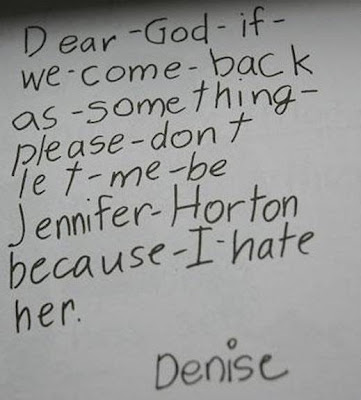
'Out of the Mouths of Babes'-- Part II-- Their Letters
A very long time ago, Art Linkletter published a little book on kids letters to God. There have been many such books and articles since. These are twelve of my favorites in their original scrawl. Children seem to have an innate sense of God, and they certainly know how to be honest in their prayers-- unlike some of us adults. Enjoy, BW3




Friday, July 13, 2007
'Out of the Mouths of Babes'-- "Lead us not into temptation, but deliver us from email."

KIDS IN CHURCH
3-year-old Reese: "Our Father, Who does art in heaven, Harold is His name. Amen."
A little boy was overheard praying: "Lord, if you can't make me a better boy, don't worry about it. I'm having a real good time like I am."
After the christening of his baby brother in church, Jason sobbed all the way home in the back seat of the car. His father asked him three times what was wrong. Finally, the boy replied, "That preacher said he wanted us brought up in a Christian home, and I wanted to stay with you guys."
I had been teaching my three-year old daughter, Caitlin, the Lord's Prayer for several evenings at bedtime. She would repeat after me the lines from the prayer. Finally, she decided to go solo. I listened with pride as she carefully enunciated each word, right up to the end of the prayer: "Lead us not into temptation," she prayed, "but deliver us from E-mail."
One particular four-year-old prayed, "And forgive us our trash baskets, as we forgive those who put trash in our baskets."
A Sunday school teacher asked her children as they were on the way to church service, "And why is it necessary to be quiet in church?" One bright little girl replied, "Because people are sleeping."
Six-year-old Angie and her four-year-old brother, Joel, were sitting together in church. Joel giggled, sang, and talked out loud. Finally, his big sister had had enough. "You're not supposed to talk out loud in church." "Why? Who's going to stop me?" Joel asked. Angie pointed to the back of the church and said, "See those two men standing by the door? They're hushers."
A mother was preparing pancakes for her sons,Kevin 5, and Ryan 3. The boys began to argue over who would get the first pancake. Their mother saw the opportunity for a moral lesson. "If Jesus were sitting here, He would say, 'Let my brother have the first pancake, I can wait.' Kevin turned to his younger brother and said, "Ryan, you be Jesus!"
A father was at the beach with his children when the four-year-old son ran up to him, grabbed his hand, and led him to the shore where a seagull lay dead in the sand. "Daddy, what happened to him?" the son asked. "He died and went to Heaven," the Dad replied. The boy thought a moment and then said, "Did God throw him back down?"
A wife invited some people to dinner. At the table, she turned to their six-year-old daughter and said, "Would you like to say the blessing?" "I wouldn't know what to say," the girl replied. "Just say what you hear Mommy say," the wife answered. The daughter bowed her head and said, "Lord, why on earth did I invite all these people to dinner?" ~~~~~~~~~~~~~~~~~~~~~~~~~~~~~~~~~~
Wednesday, July 11, 2007
New Mary Magdalene Revelation

Rivaling the discovering of the Talpiot Tomb itself is this new revelation presented above in a news source almost as reliable as the recent book on the tomb of Jesus. Who knew that the M+M on that candy actually stood for Mary Magdalene!!!
You just never know where ole Mary Magdalene may pop up next and who she might be linked with. It would be interesting to see her on an episode of "Desperate Housewives". I can only imagine the stories she could tell about being married to Jesus-- "Cooking for that man was just impossible-- he demanded that everything be just perfect". Or perhaps we may hope to see an image of her appear on a barn in Nebraska. Me personally I am holding out for the line of Mary Magdalene clothes and accessories. I gather they're doing something with bringing out a new line of burkas as well with her label on them.
Stay tuned for further revelations about Mary Magdalene. You may yet prove to be one of her descendants :)
The Virtual Church on the Rise

If you snooze you lose, and you may feel the heat sooner rather than later.
For example, have you been attending church online of late? What, you didn't know you could attend church, or synagogue, or the mosque on line? Well yes, you can, sort of. Now, I am not talking about a web link to a live worship service in a real church. No, I am talking about websites where you can go to pray, to network, to join others in studying the Bible, to exchange pictures, and so on, and no they are not just glorified chat rooms.
Consider for example, this recent article from the NY Times about holy space on the internet--
http://www.nytimes.com/2007/06/30/us/30religion.html?th&emc=th
For example, have you checked out www.hisholyspace.com and www.xianz.com or
www.mypraize.com? How about www.holypal.com ?
One thing these sites have in common is that they are strictly monitored, prayer is encouraged , foul language is banned and good things happen. One of the reasons for the rise of such sites is to provide an alternative to the My Space site which sometimes has racy adds and other content and participants offensive to many Christians. If you think I am being overly cautious when it comes to MySpace, the Times article drops this little bomb--
"Last month, MySpace agreed to hand over the names, addresses and online profiles of convicted sex offenders after attorneys general from eight states demanded that the site, which is owned by Fox Interactive Media, do so. MySpace also deleted the profiles of 7,000 convicted sex offenders." There are wolves and other predators out there you know.
If you'd like to try something fun and Jewish try www.shmooze.com, though you might want to sift it a bit before you let your children loose on it.
In my view, there is no real danger of this phenomenon replacing the real church, or even the church newsletter, but it certainly reveals that Christian people are looking for contact with unknown but like minded Christian folks. And there is nothing inherently wrong with that. We used to write pen pal letters. Now people go to websites and make friends from around the world and have their faith nurtured.
Several things about my own teaching online have made me think of Gal. 3.28 where Paul tells us something of what the church ought to look like-- a place where ethnic, social, and gender differences should not be allowed to determine how we are viewed, or for that matter what roles we play in church. In some ways, it is easier to accomplish Gal. 3.28 online.
What I have discovered is that online, and without picture IDs you have only minds-- there are no handicaps, no race, no gender, no social impairs, no elites-- just minds. Various sorts of folks who would not normally speak up in a real class are often the most vocal online because their negative inhibiting factors are gone. Check out the websites and see what you think-- in the meantime look at the picture above again and remember---
You've got to be flexible to get near to the heat and action without getting burned.
Friday, July 06, 2007
'Sicko'-- It's Enough to make you ill
Michael Moore, our current resident agent provocateur and gadfly is at it again, and this time he really hits you where it hurts-- in the pocketbook. His bright searchlight of investigation casts it glare on the health care industry, and more specifically on the health insurance and HMO juggernaut. I have to tell you that even if only a minority of what is said in this docu-drama is true, it confirms most of our suspicions that we are being had by our insurance companies and health care providers. It is of course always possible to complain about the odd injustice when someone falls between the cracks. But Moore is dealing not with the abuses of the system but rather its inherent and systemic problems.
When you peel away the shiny veneer of the health care industry and discover that 'managed care' has as its main goal the making of money and thereby the limiting of care, even to those who most need it, then the situation is grave indeed. Moore takes various of those folks who were involved in the rescue efforts in NY at ground zero, and not merely chronicles their on going health woes-- losing jobs, losing homes, losing faith in the American way, but he takes these folks on a journey to Gitmo in Cuba and eventually to a hospital in Havana where they get much better and very much cheaper help for what ails them than they had been able to get in America. Shameful. Call this demagoguery if you like, but it makes the point. Our system is screwed up.
Some of the more devastating revelations of this docu-drama are: 1) we owe to Tricky Dick in collusion with Mr. Kaiser (of Kaiser Permanente fame) in 1971 the rise of the HMO for profit scheme. The White House Tapes do not lie when they tell us that the specific goal of the new health care system was to make money, and minimize care when it was not profitable to give care. So much for the hypocratic oath; 2) Moore documents how every single major Western nation except the US has a universal health care system of some sort which has not bankrupted the nation, nor prevented doctors from making a good living, nor caused rampant anti-democracy notions. Indeed he documents how universal health care was a natural outgrowth of democracy not socialism, a natural effort after WWII in Europe to do a better job as a society of looking after all its citizens, because the cries of many, including the least and the last in society were finally being heard, and their votes were making a difference. 3) One of the more telling remarks was that in European democracies the government is afraid of the power of the people and listens to their protests and legitimate cries for health care, whereas in the U.S. the people are afraid of the government, of it becoming too controlling and the like, and this then inhibits even legitimate national programs like the Postal Service, or Public Libraries, or Police and Firefighters or interstate roads and highways being adequately funded. It is this same fear of 'big brother' that has made a universal health care system a hard sell in America, whilst by and large it is a runaway success in Canada. It is just heartbreaking to hear some of the stories of people refused treatment who either die, or remain maimed or become homeless because the cost of their health care either prevented them from getting treatment or alternately bankrupted them when they got treatment anyway.
The film is under two hours, but it has more of a clear flow and direction than Moore's previous films. It uses the same montage kind of approach, allowing people to tell their personal stories and allowing that in itself to generate the pathos of the movie. We watch a man sow up his own wound caused by a work accident because he has no health insurance. We see a woman dumped in front of the Salvation Army, having been put in a taxi and sent there by a hospital who decided not to complete treating this woman who needed antibiotics and stitches for a head wound. We see a woman lose her daughter because in her panic she took her to the nearest hospital which refused her care, even though the mother herself worked for a hospital in town. Care was refused because it was an 'out of network' hospital closer to where her daughter became ill that she had first taken her child. We hear the testimony before Congress of a woman who was in health care management and was promoted time and again because she 'saved' the health care provider so much money by refusing care to patients in need. And the beat goes on. We see Americans driving across the border to Canada because they can't afford their heart medicine, their cancer treatment, their surgeries in the U.S.
Some 50 million Americans today are without any kind of health care or health insurance. I mean None. Of the 250 million insured, most have health insurance which has so many exclusions for pre-existing conditions, or just recurring conditions that the insurance does not help them when they most need it. It's a national scandal to say the least. And then we are regaled with those who lobby our Congressmen and Senators for the health care industry-- giving out enormous pay offs to both Republicans and Democrats so the health care industry and its pharmaceutical allies can keep making huge profits.
Some of this comes pretty close to home for me. The cost of my cholesterol and blood pressure medicine (both hereditary issues in my case) are very steep and are not covered by my health insurance. Some days you just ask-- what good is it, this whole system? It doesn't even work well for those who can afford to pay for health insurance.
Say what you will about Michael Moore, love him or hate him, he knows how to make us think about what needs to be changed about our society. Certainly the health care industry would be a good place to start. When you realize that the Great Physician himself could not have afforded health care in this system, and would have been censured by the AMA for practicing medicine without their approval, you realize something is wrong with this picture. To say the least.
When you peel away the shiny veneer of the health care industry and discover that 'managed care' has as its main goal the making of money and thereby the limiting of care, even to those who most need it, then the situation is grave indeed. Moore takes various of those folks who were involved in the rescue efforts in NY at ground zero, and not merely chronicles their on going health woes-- losing jobs, losing homes, losing faith in the American way, but he takes these folks on a journey to Gitmo in Cuba and eventually to a hospital in Havana where they get much better and very much cheaper help for what ails them than they had been able to get in America. Shameful. Call this demagoguery if you like, but it makes the point. Our system is screwed up.
Some of the more devastating revelations of this docu-drama are: 1) we owe to Tricky Dick in collusion with Mr. Kaiser (of Kaiser Permanente fame) in 1971 the rise of the HMO for profit scheme. The White House Tapes do not lie when they tell us that the specific goal of the new health care system was to make money, and minimize care when it was not profitable to give care. So much for the hypocratic oath; 2) Moore documents how every single major Western nation except the US has a universal health care system of some sort which has not bankrupted the nation, nor prevented doctors from making a good living, nor caused rampant anti-democracy notions. Indeed he documents how universal health care was a natural outgrowth of democracy not socialism, a natural effort after WWII in Europe to do a better job as a society of looking after all its citizens, because the cries of many, including the least and the last in society were finally being heard, and their votes were making a difference. 3) One of the more telling remarks was that in European democracies the government is afraid of the power of the people and listens to their protests and legitimate cries for health care, whereas in the U.S. the people are afraid of the government, of it becoming too controlling and the like, and this then inhibits even legitimate national programs like the Postal Service, or Public Libraries, or Police and Firefighters or interstate roads and highways being adequately funded. It is this same fear of 'big brother' that has made a universal health care system a hard sell in America, whilst by and large it is a runaway success in Canada. It is just heartbreaking to hear some of the stories of people refused treatment who either die, or remain maimed or become homeless because the cost of their health care either prevented them from getting treatment or alternately bankrupted them when they got treatment anyway.
The film is under two hours, but it has more of a clear flow and direction than Moore's previous films. It uses the same montage kind of approach, allowing people to tell their personal stories and allowing that in itself to generate the pathos of the movie. We watch a man sow up his own wound caused by a work accident because he has no health insurance. We see a woman dumped in front of the Salvation Army, having been put in a taxi and sent there by a hospital who decided not to complete treating this woman who needed antibiotics and stitches for a head wound. We see a woman lose her daughter because in her panic she took her to the nearest hospital which refused her care, even though the mother herself worked for a hospital in town. Care was refused because it was an 'out of network' hospital closer to where her daughter became ill that she had first taken her child. We hear the testimony before Congress of a woman who was in health care management and was promoted time and again because she 'saved' the health care provider so much money by refusing care to patients in need. And the beat goes on. We see Americans driving across the border to Canada because they can't afford their heart medicine, their cancer treatment, their surgeries in the U.S.
Some 50 million Americans today are without any kind of health care or health insurance. I mean None. Of the 250 million insured, most have health insurance which has so many exclusions for pre-existing conditions, or just recurring conditions that the insurance does not help them when they most need it. It's a national scandal to say the least. And then we are regaled with those who lobby our Congressmen and Senators for the health care industry-- giving out enormous pay offs to both Republicans and Democrats so the health care industry and its pharmaceutical allies can keep making huge profits.
Some of this comes pretty close to home for me. The cost of my cholesterol and blood pressure medicine (both hereditary issues in my case) are very steep and are not covered by my health insurance. Some days you just ask-- what good is it, this whole system? It doesn't even work well for those who can afford to pay for health insurance.
Say what you will about Michael Moore, love him or hate him, he knows how to make us think about what needs to be changed about our society. Certainly the health care industry would be a good place to start. When you realize that the Great Physician himself could not have afforded health care in this system, and would have been censured by the AMA for practicing medicine without their approval, you realize something is wrong with this picture. To say the least.
A Bridge over 'Troubled Waters'-- Rethinking our Theology of Baptism

I was watching the PBS special the other night in which Paul Simon was honored for a career of great song writing with the very first Gershwin Award of the Library of Congress-- certainly a well deserved tribute. Of course one of his most famous songs, actually sung mainly by his partner Art Garfunkel, was "Bridge over Troubled Waters". In a sense, my new book on baptism is meant not merely to further stir up the always boiling pot of baptismal discussion, but to see if we can't get beyond the usual Baptist vs. Paedobaptist deadlock when it comes to discussing this issue especially in Evangelical and more general Protestant discussion.
What I am arguing is that a good deal of water has been shipped by both Baptists and Paedopbaptists when it comes to their theology of baptism, and we need to return ad fontes (yes, the baptismal font) and rethink some of these things in the light of Scripture and earliest Christian practice, rather than in the light of much later Christian squabbles about baptism, especially those generated by the Reformation.
What I am arguing is that there is not really so clear a delineation of what a theology and practice of baptism should look like in the NT that either a strictly Baptistic or a more broad practice can clearly be ruled in or out. In fact, we have no chapters at all in the NT about how and by whom baptism should actually be administered, unlike what we find in the later Christian tract called the Didache. This is surely why we continue to debate and disagree about this very matter.
And no, the Greek verb 'baptidzo' itself does not specify a specific quantity of water to be used, though doubtless immersion is a better symbol of being baptized into Christ's death than other modes of the practice. 'Baptidzo' for example in the Didache is used to describe the practice of pouring water over someone's head, not immersion. This verb does not necessarily imply the ancient equivalent of a watery slam dunk :)
One of the burdens of my little study is to make clear that part of the confusion about baptism comes from the failure to recognize certain facts: 1) water baptism is one thing, the use of the language of water to describe spiritual experiences is quite another. To put it differently water and Spirit baptism are distinguishable things which do not necessarily happen together or at the same time, though that is also possible. Water does not inherently convey Spirit, and reception of the Spirit does not necessarily involve water baptism. This is perfectly clear from a close examination of Acts where we have several patterns--- water followed by Spirit reception, Spirit preceding water baptism, Spirit received without any Christian water baptism for a long period of time (e.g. Apollos), and a few places where water baptism and the reception of the Spirit seem to be nearly simultaneously (e.g. the Ethiopian eunuch). Conclusion--- there is no one mandated pattern or order of these things in the NT. 2) I am also stressing in this book that there are many places where the language of water baptism and its rich symbolism are used to describe a spiritual experience, NOT what happens in or by means of the rite of water baptism itself. Paul for example in 1 Cor. 12 talks about all believers being baptized into one body, not by the minister, but by the Holy Spirit! In this selfsame document he says he is thankful that he did not water baptize more Corinthians, because apparently they tended to take a magical view of what resulted from such a ritual. 3) I am also stressing that too often both the Baptist and Paedobaptist practices have, for the sake of regularity and control, misunderstood the meaning of baptism. Baptism is neither a Christian dedication ritual nor a Christian equivalent to a bar mitzvah-- a rite of passage for a young adult prepared to assume the mantle of his faith consciously and on his own. Baptism in the NT is a rite of initiation, and should be practiced on anyone who is at the point of entering the covenant community or has already done so, whatever their age. Once one has crossed the boundary from the world into Christ one should already have the initiation ritual, the rite of passage into the community. All the baptisms in Acts are missionary baptisms. The book of Acts neither raises nor answers the second generation question-- what do we do with children born into and raised in Christian families who know no other way of life? Should we treat them like little heathens, or are they already a provisional part of the covenant community? 1 Cor. 7 suggests the children of even one Christian parent is 'holy' that is, set apart for God, and not unclean. Acts and Paul's letters (see 1 Cor. 1) as well talks about the baptism of whole households. Were there really no infants in any of these households? These are the right kinds of questions to raise when thinking about how we practice baptism today. Basically we have turned this ritual into something we can manage and do at a specific or regular point in time-- in infancy, or when someone comes of age, or in the rarer case of an adult convert, as soon as they convert. 4) I have shown at length that there is no clear statement in the NT that suggests baptism must be preceded by a confession of faith. Acts 8 and the eunuch story is no exception, if we look at the likely original form of this text, and not its later Western text additions.
I also suggest in this book that we need to be able to distinguish baptism and the Lord's Supper. One is a rite of initiation, the other is a ceremony of confirmation. One is about union with Christ, the other about communion in Christ. One is a passive sacrament, performed for the recipient, the other is a sacrament which requires active participation, active recognizing of the Body, and partaking of the elements. The failure to see the differences between these two sacraments causes continual confusion. And then there is this fact-- a rite of initiation, as a form of a rite of passage, can and should by definition only transpire once in a person's life. As the old saying goes, you can only step into the stream for the first time once. Yet sadly, as my friend Chuck Killian remarked about his own experience growing up in Indiana, in revivalistic circles you may end up going to the altar so many times and being 'born again' so many times that you have stretch-marks on your soul!!!
The reason baptism is said to be 'one' in Ephesians is because it should only be practiced once. You can only be 'initiated' into a religion for the first time once. Our confusion about baptism, even stretches to our confusion about what is symbolized in baptism-- does it symbolize the divine initiative of grace for us, or does it mainly symbolize our response to that initiative? In my view it is intended to symbolize the former, while the Lord's Supper symbolizes the latter. In other words, no one in the early church was asking- "should we withhold baptism from some members of this household until they come of age?" for the very good reason that they saw baptism as an outer and visible sign of what God was doing for and in that family, not, or at least not primarily, a symbol of the human response to God's initiative.
There is a good deal of detailed exegetical discussion in this book and also an attempt to help us all get beyond anachronism-- the reading back into the text of later church practices and notions about baptism. I am also stressing that we need to respect each others practices, since the NT does not clearly mandate exactly how the rite should be performed and on whom, much less where. This I think means, no rebaptisms. If baptism is to be seen as 'one' as Ephes. 4 suggestions, we need to stop the practice of rebaptisms as it violates what the ritual was intended to symbolize-- initiation into Christ and his body. We can have ceremonies of remembering one's baptism and being thankful, but no rebaptisms please unless you just don't think the NT theology of baptism matters much when it comes to praxis. Though Baptists and Paedo-baptists stand on opposite sides of the baptismal waters, I would hope in the 21rst century we could take time to learn about and respect each others legitimate practices, even if we have disagreements about them. Put another way-- the world is watching. If we can't even show respect and mutual support when it comes to the initiation ritual into Christ, who should anyone think there is a 'one true church apostolic and universal'?
Think on these things.
Tuesday, July 03, 2007
Live Free or Die Hard-- or Live Hard and Die Free?
I have always liked Bruce Willis. He was great in the 80s in the big TV hit series Moonlighting with Cybil Shepherd. In fact, he began the 'Die Hard' series in the middle of the Moonlighting show because Cybil became pregnant and they had to take a little hiatus. It was fortunate for Bruce, because he was able to successfully make the transition to the big screen right off the bat as 'Die Hard' I was a big hit-- a lot of bang for the buck. Bruce branched out to various other roles, many of them military or militant, but he also did charming films like 'The Fifth Element' which reprised some of his wry wit seen on Moonlighting. 'Live Free or Die Hard' is not in that vein, but in my estimation it is the best of the Die Hard films-- by far. But now at 52, bald, but still buff, we are regaled with one more episode in the McClane saga.
The subject of this movie is cyber-terrorism-- a timely subject indeed. The bad guy is named Gabriel, only he is an avenging angel rather than a protecting one, who once worked for the Federal Government as a Geek supreme, but the government would not listen to him when he told them the whole computer network running the nation could be hacked into and messed with. Indeed, they fired him for a 'stunt' namely breaking into an Oval Office meeting and showing them how on his laptop he could personally shut down the whole Norad Defense system.
In other words, the movie is predicated on the revenge motive, but it is also about getting rich quick, and as it turns out Gabriel, unlike most hackers, is prepared to actually physically kill whoever tries to get in his way. Enter John McClane, and his rebellious daughter, and a computer hacker named Matthew Farrell, who has unwittingly been helping Gabriel prepare to do his dirty work. Farrell is played quite nicely by the Keanu Reeves look alike Justin Long-- the Apple guy. You know-- the one who does all those commercials with another guy who plays a PC. He's the cool one. Only Farrell is far more geek-like than Gabriel-- he wouldn't physically harm a fly, or so he thought before he ran into John McClane.
Several things you need to know about this movie-- its PG 13, but it has an awful lot of violence for a PG-13 film, so I don't advise taking the younger kids to this film during this holiday, not least because it continues the mythical premise that Americans have so long bought into-- we can solve all our problems by just blowing away the bad guys.
Unfortunately this attitude fails to deal with the fallen human nature that all of us struggle with, stigmatizing a particularly virulent and violent form of sinner as the root cause of all our troubles. This is what the psychologists call 'projection'-- the projecting of all the evils and problems onto a scapegoat, which then relieves us of having to be introspective and ask whether or not we might as well be the source of many of humankind's woes. Of course Gabriel in this movie certainly is wicked, and deserving of punishment not doubt. But what of the criminal ignorance and negligence of the government who ignored his warning about security breaches, having already had him build their NRA security system, and then never bothered to change it once he was fired? There is more than enough blame to go around when major crises hit, like the one depicted in this film. But I digress.
Another thing you need to know is that the second major premise of this movie is that McClane is indeed like the old Timex watch-- he takes many a licking but keeps on ticking. He should have been dead about twenty times in this movie, and it gets to the point of absurdity at several junctures. No mere mortal just gets up and walks away after falling several stories from a building, or being in multiple huge car crashes. Suspending your disbelief is a pre-requisite to watching this film.
And this brings up an important point. This movie feeds the Rambo spirit of many Americans, who would like nothing better than to be John McClane and personally eliminate those who bewitch, bother, and bewilder them. The cheers in the theater for McClane in this movie were understandable but chilling none the less. Apparently we would really like to be this guy-- mowing down the bad guys, and yet walking away with minor injuries and no repercussions. But there is another message in this movie.
The message is that we need the geeks of this world to help us save the world. Mere guts and determination are not enough. Even in this movie, John McClane is not enough to save the world-- Matthew Farrell in fact is crucial at various points to making it happen. So now we are led to believe that with enough guts and computer savvy and skills we can save ourselves from our enemies. The bad guys are smart, but with enough courage, macho, and geekiness we can out wit them. But is it so?
There are some spectacular stunts and special effects in this movie-- not the least of which is watching a car hurtling through the air taking down a chopper, because McClane ran out of bullets. There is also the pathos of McClane's daughter Lucy being caught in the web of the evil genius Gabriel. And there is the bonding between Farrell and McClane as the movie goes on. What I am telling you is that the movie is not just all non-stop action and special effects and stunts. There is a little bit of character development, and this actually helps draw the audience in and help them stay on the roller coaster ride of this film, which is intense and in spots suspensful, to say the least.
Movies of these kinds, disaster movies, serve as cinematic apocalyptic warnings-- shouting 'what if.....'. But the questions they raise, are how could we better prepare for wickedness let loose on humankind? If this movie has a subliminal message it would seem to be that we need to listen to one another, to not remain arrogant and ignorant, and to take good advice and wisdom where ever it can be found-- even on the lips of a scruffy computer geek called Warlock who lives with a doomsday mentality and believes in governmental conspiracy theories on a grand scale ('Big Brother is out to get you').
Perhaps in the end this movie should have been entitled 'Live Hard, and Die Free'. In other words, be prepared to fight and kill for what you really most value. That is the ethic McClane actually embodies. Nowhere does anyone in films like this ever ask the question-- if I use the same weapons, the same tactics, the same brutality, the same 'I am above the law' attitude, and the same violence to achieve my ends and aims (however noble in principle), haven't I just become just like what I despise??? What is the real difference between McClane and Gabriel-- who both get off on violence? While the movie clearly intimates there is a good guy and a bad guy in this film, their respective modus operandi are notably the same and so it becomes hard to tell the difference at least when it comes to means, if not ends.
It has been said in our utilitarian age that 'the ends justify the means'. I disagree. Some ends are not ever best served by killing. Indeed killing violates the ends of God-- including truth, right, love, compassion, self-sacrifice, peace and various other Gospel principles. But then our culture has long been built on venerating the warrior not the saint, King David, not King Jesus.
Is it an accident that in the trailers for this movie we have the slogan'' In McClane we Trust"? I think not. Because the truth is, we do trust the warrior more than we trust the saint, we do trust our own military might and intelligence far more than we trust God.
After all what do we celebrate on the 4th of July?-- the founding of a nation on the basis of revolutionary actions taken against the established legitimate authorities from Britain. And how in the world does that comport with what Rom. 13 or 1 Peter has to say about respecting and honoring the governing authorities, even when the references in those texts are to Emperors who did not run democracies? Well, it doesn't comport with it, and those are the cold hard Biblical facts.
Think on these things.
The subject of this movie is cyber-terrorism-- a timely subject indeed. The bad guy is named Gabriel, only he is an avenging angel rather than a protecting one, who once worked for the Federal Government as a Geek supreme, but the government would not listen to him when he told them the whole computer network running the nation could be hacked into and messed with. Indeed, they fired him for a 'stunt' namely breaking into an Oval Office meeting and showing them how on his laptop he could personally shut down the whole Norad Defense system.
In other words, the movie is predicated on the revenge motive, but it is also about getting rich quick, and as it turns out Gabriel, unlike most hackers, is prepared to actually physically kill whoever tries to get in his way. Enter John McClane, and his rebellious daughter, and a computer hacker named Matthew Farrell, who has unwittingly been helping Gabriel prepare to do his dirty work. Farrell is played quite nicely by the Keanu Reeves look alike Justin Long-- the Apple guy. You know-- the one who does all those commercials with another guy who plays a PC. He's the cool one. Only Farrell is far more geek-like than Gabriel-- he wouldn't physically harm a fly, or so he thought before he ran into John McClane.
Several things you need to know about this movie-- its PG 13, but it has an awful lot of violence for a PG-13 film, so I don't advise taking the younger kids to this film during this holiday, not least because it continues the mythical premise that Americans have so long bought into-- we can solve all our problems by just blowing away the bad guys.
Unfortunately this attitude fails to deal with the fallen human nature that all of us struggle with, stigmatizing a particularly virulent and violent form of sinner as the root cause of all our troubles. This is what the psychologists call 'projection'-- the projecting of all the evils and problems onto a scapegoat, which then relieves us of having to be introspective and ask whether or not we might as well be the source of many of humankind's woes. Of course Gabriel in this movie certainly is wicked, and deserving of punishment not doubt. But what of the criminal ignorance and negligence of the government who ignored his warning about security breaches, having already had him build their NRA security system, and then never bothered to change it once he was fired? There is more than enough blame to go around when major crises hit, like the one depicted in this film. But I digress.
Another thing you need to know is that the second major premise of this movie is that McClane is indeed like the old Timex watch-- he takes many a licking but keeps on ticking. He should have been dead about twenty times in this movie, and it gets to the point of absurdity at several junctures. No mere mortal just gets up and walks away after falling several stories from a building, or being in multiple huge car crashes. Suspending your disbelief is a pre-requisite to watching this film.
And this brings up an important point. This movie feeds the Rambo spirit of many Americans, who would like nothing better than to be John McClane and personally eliminate those who bewitch, bother, and bewilder them. The cheers in the theater for McClane in this movie were understandable but chilling none the less. Apparently we would really like to be this guy-- mowing down the bad guys, and yet walking away with minor injuries and no repercussions. But there is another message in this movie.
The message is that we need the geeks of this world to help us save the world. Mere guts and determination are not enough. Even in this movie, John McClane is not enough to save the world-- Matthew Farrell in fact is crucial at various points to making it happen. So now we are led to believe that with enough guts and computer savvy and skills we can save ourselves from our enemies. The bad guys are smart, but with enough courage, macho, and geekiness we can out wit them. But is it so?
There are some spectacular stunts and special effects in this movie-- not the least of which is watching a car hurtling through the air taking down a chopper, because McClane ran out of bullets. There is also the pathos of McClane's daughter Lucy being caught in the web of the evil genius Gabriel. And there is the bonding between Farrell and McClane as the movie goes on. What I am telling you is that the movie is not just all non-stop action and special effects and stunts. There is a little bit of character development, and this actually helps draw the audience in and help them stay on the roller coaster ride of this film, which is intense and in spots suspensful, to say the least.
Movies of these kinds, disaster movies, serve as cinematic apocalyptic warnings-- shouting 'what if.....'. But the questions they raise, are how could we better prepare for wickedness let loose on humankind? If this movie has a subliminal message it would seem to be that we need to listen to one another, to not remain arrogant and ignorant, and to take good advice and wisdom where ever it can be found-- even on the lips of a scruffy computer geek called Warlock who lives with a doomsday mentality and believes in governmental conspiracy theories on a grand scale ('Big Brother is out to get you').
Perhaps in the end this movie should have been entitled 'Live Hard, and Die Free'. In other words, be prepared to fight and kill for what you really most value. That is the ethic McClane actually embodies. Nowhere does anyone in films like this ever ask the question-- if I use the same weapons, the same tactics, the same brutality, the same 'I am above the law' attitude, and the same violence to achieve my ends and aims (however noble in principle), haven't I just become just like what I despise??? What is the real difference between McClane and Gabriel-- who both get off on violence? While the movie clearly intimates there is a good guy and a bad guy in this film, their respective modus operandi are notably the same and so it becomes hard to tell the difference at least when it comes to means, if not ends.
It has been said in our utilitarian age that 'the ends justify the means'. I disagree. Some ends are not ever best served by killing. Indeed killing violates the ends of God-- including truth, right, love, compassion, self-sacrifice, peace and various other Gospel principles. But then our culture has long been built on venerating the warrior not the saint, King David, not King Jesus.
Is it an accident that in the trailers for this movie we have the slogan'' In McClane we Trust"? I think not. Because the truth is, we do trust the warrior more than we trust the saint, we do trust our own military might and intelligence far more than we trust God.
After all what do we celebrate on the 4th of July?-- the founding of a nation on the basis of revolutionary actions taken against the established legitimate authorities from Britain. And how in the world does that comport with what Rom. 13 or 1 Peter has to say about respecting and honoring the governing authorities, even when the references in those texts are to Emperors who did not run democracies? Well, it doesn't comport with it, and those are the cold hard Biblical facts.
Think on these things.
Monday, July 02, 2007
'Ratatouille'-- A Midsummer's Gourmet Treat
You have to hand it to Pixar and Brad Bird, they are good at what they do. They have brought us so many instantly appealing CG cartoon movies (beginning with Toy Story) that they sometimes appear to have invented the genre. And in a summer of mediocre sequels its nice to finally have something new and fresh. Of course on the face of it the premise is ridiculous-- a French rat named Remy who longs to be a gourmet chef, having been inspired by the famous Mssr. Gusteau (no not Jacques). So we are asked from the outset to completely suspend our disbelief. But this movie sure makes it easy.
First of all, the movie is visually beautiful. The re-creation of Paris is both stunningly realistic and recognizable for those who have spent time there, and at the same time gives the feel for life along the Seine river. What is even more stunning is that it does so from a rat's eye view-- you are seeing everything from near ground level most of the time. You begin to empathize with the rats what with all the obstacles in their path to survive (I never thought I'd say that). And indeed Remy is the most charming of all the many rats in the film, precisely because he is the most like a human being (he even regularly walks on two legs and can read and loves the French cooking channel).
Second there is the primary scene-- the restaurant of Gusteau, who is now deceased and his restaurant in decline, but still full of good cooks, indeed so many that one wonders how the broth isn't consistently spoiled. You get a behind the scenes feel for a major restaurant's various speciality chefs (patisserie chef, sous chef etc.) The head chef however is a real villian, even less likeable than the great food critic aptly named Anton Ego who reminds one of that arch-villaness Cruella Deville of Disney days gone by. The head chef is on the make, seeking to take over the restaurant and working on various franchising fast food deals (while Gusteau is rolling over in his grave).
The plot doesn't just stick to the story line of 'my life as a rat', but rather deals with the interesting interplay between Remy and a young man who wants to be a chef but can't cook a lick. This problem is solved when Remy is allowed to pull the young man's strings, or at least his hair (you have to see it to believe it). The surprise is whose son this young man turns out to be. Along the way you have loss, redemption, love, love lost and re-found, humorous sketches of rats searching for and feasting on all sorts of garbage and real food as well. The humor is good, the story does not have any real lulls or complete downers, but there is plenty of action and suspense as well. One of the things that does seem surprisingly missing is music, specifically the typical accordion music of Paris, but then you can't have everything.
This movie is probably an instant classic, not least because of its cinematography and creative story line (what will we have next -- hyenas as stand up comics???), and will probably get various Oscar nods, but what should not be missed is that the story has a serious message, which is not the apparent theme of the movie ('anyone can cook'-- well, not really just anyone), but rather the message that one must not give up on one's dreams and must strive to be one's best self through life's ups and downs. Even a rat can over achieve given a chance.
This is the perfect July Fourth movie to take your children to. Especially the young ones will fall in love with Remy-- he's pretty likeable. The movie is not too long ( one hour 51 minutes and has a 95% approval rating by critics-- a rarity), nor too slow paced, and there is humor along the way for the adults as well. It comes packaged with a short subject called "Lifted" about a space cadet, who just can't get the tractor beam on the space ship to work quite right. It proves to be a palatable short subject that is a very mild appetizer before the main course shows up. Go and enjoy this film--- Bon appetit.
First of all, the movie is visually beautiful. The re-creation of Paris is both stunningly realistic and recognizable for those who have spent time there, and at the same time gives the feel for life along the Seine river. What is even more stunning is that it does so from a rat's eye view-- you are seeing everything from near ground level most of the time. You begin to empathize with the rats what with all the obstacles in their path to survive (I never thought I'd say that). And indeed Remy is the most charming of all the many rats in the film, precisely because he is the most like a human being (he even regularly walks on two legs and can read and loves the French cooking channel).
Second there is the primary scene-- the restaurant of Gusteau, who is now deceased and his restaurant in decline, but still full of good cooks, indeed so many that one wonders how the broth isn't consistently spoiled. You get a behind the scenes feel for a major restaurant's various speciality chefs (patisserie chef, sous chef etc.) The head chef however is a real villian, even less likeable than the great food critic aptly named Anton Ego who reminds one of that arch-villaness Cruella Deville of Disney days gone by. The head chef is on the make, seeking to take over the restaurant and working on various franchising fast food deals (while Gusteau is rolling over in his grave).
The plot doesn't just stick to the story line of 'my life as a rat', but rather deals with the interesting interplay between Remy and a young man who wants to be a chef but can't cook a lick. This problem is solved when Remy is allowed to pull the young man's strings, or at least his hair (you have to see it to believe it). The surprise is whose son this young man turns out to be. Along the way you have loss, redemption, love, love lost and re-found, humorous sketches of rats searching for and feasting on all sorts of garbage and real food as well. The humor is good, the story does not have any real lulls or complete downers, but there is plenty of action and suspense as well. One of the things that does seem surprisingly missing is music, specifically the typical accordion music of Paris, but then you can't have everything.
This movie is probably an instant classic, not least because of its cinematography and creative story line (what will we have next -- hyenas as stand up comics???), and will probably get various Oscar nods, but what should not be missed is that the story has a serious message, which is not the apparent theme of the movie ('anyone can cook'-- well, not really just anyone), but rather the message that one must not give up on one's dreams and must strive to be one's best self through life's ups and downs. Even a rat can over achieve given a chance.
This is the perfect July Fourth movie to take your children to. Especially the young ones will fall in love with Remy-- he's pretty likeable. The movie is not too long ( one hour 51 minutes and has a 95% approval rating by critics-- a rarity), nor too slow paced, and there is humor along the way for the adults as well. It comes packaged with a short subject called "Lifted" about a space cadet, who just can't get the tractor beam on the space ship to work quite right. It proves to be a palatable short subject that is a very mild appetizer before the main course shows up. Go and enjoy this film--- Bon appetit.
To Ur is Human


The town of Shanli-Urfa is an interesting one. According to Islamic tradition it is the locale of the cave of Abraham. Above you will find a picture of the entrance to the cave, followed by an overview of the citadel that towers over that part of the town, followed by the arches leading into the sacred pool (full o0f enormous and enormously pamper fish) next to the cave, followed the black and white entrance way into the park and the mosque next to the pool and the cave.
According to Islamic tradition, Abraham had a mighty battle with the Devil and the powers of evil on top of the citadel and was thrown off the cliff into the pool below, but the fish held him up and prevented him from drowning, hence they became revered and sacred fish ever since. When I went into the cave of Abraham, there was an old man in there praying. I wish I could have taken his picture. He had on a white prayer cap, had a long white beard, and could have been an image of Abraham himself.
Alas, for all these traditions they probably have no basis in history. The Biblical Ur of the Chaldees was likely a long way from Urfa, somewhere in Iraq. If you read Gen. 11.27-32 carefully it suggests that Terah set out from one land, went to another where Haran was, on the way to Canaan. If you were journeying from Turkish Urfa to Haran today it would be a journey of about one or two days maximum, and in Abraham's time it would not be a journey away from the land of the Chaldeans to Canaan by way of Haran. In other words, Gen. 11 suggests a journey from the fertile crescent region to Haran, not from Urfa to Haran. If this is so, then of course all the Abrahamic traditions associated with Shali -Urfa are not historical. They are the products of later Islamic tradition. It seems they erred about Ur.
And this brings up an important point. People are often asking me-- Do all these historical details really matter? Does it really matter where Abraham was born and married? Does it really matter where Haran is? And so on. Well yes indeed it matters a good deal 'if' the Bible is making historical claims about such things. The authority and inspiration of the Bible is at stake in such matters, if the Bible is making historical claims. Likewise with Islam, when Islamic tradition makes claims about Abraham, if they are not grounded in history, then they have no real basis, and are not true. Christianity like Islam, like Judaism is an historical religion-- a religion based on certain truth claims about history. Of course not all history is equally important, but the point is that when the Bible makes a claim about history, then it should be considered important by us. What do we actually learn about history from a trip to Shanli Urfa (the name means beautiful Urfa)?
Below you you will see two steles. The first was found near Urfa and is the stele of an Assyrian king shaking hands with a deity apparently. This seems to be either Ashurbanipal, or it might be Nabonidus. Below that is a Greco-Roman grave stele found in Urfa. Both of these monuments are in the little Urfa museum. The Roman stele is interesting because it has the top of a temple with a rosette in it above the eagle. This is close to what was found at the Talpiot tomb which we blogged about sometime ago, and shows this was a common architectural design used with tomb art, and that it depicts a temple cornice. In short there can be no doubt that Urfa is in the middle of territory where many historical figures of importance to Biblical studies passed through, and many cultural artifacts have been found that help us in a general way better understand Biblical culture. But as for Abraham having a battle with the Devil or an evil angel in Urfa--- not so much. This is a later tradition which was meant to give special sacred status to this town of Urfa. Think on these things.


Subscribe to:
Posts (Atom)